
In a healthcare system where interoperability is fully realized, a patient’s medical history would seamlessly follow them, whether they’re in the emergency room, visiting a primary care physician, or consulting with a specialist across town. This vision is becoming increasingly achievable with the power of technology, which enables the secure and efficient exchange of health data across different systems. Interoperability ensures that no matter which healthcare provider a patient goes to, they have access to the patient’s most up-to-date information, facilitating better decision-making and more coordinated care. Interoperability is a crucial tool for improving patient outcomes, reducing errors, and enhancing the overall patient experience. Achieving this requires overcoming significant barriers within fragmented healthcare environments, where systems often operate in isolation.
Studies show that lack of healthcare data interoperability costs the U.S. healthcare industry over $30 Bn annually, emphasizing the urgent need to address the challenges of the current fragmented system1. In a fragmented healthcare system, critical patient data is often locked in separate silos across disparate systems used by different departments and facilities, making it challenging to share important health information amongst each other. Electronic health records (EHRs), laboratory systems, and radiology systems, for example, may not communicate effectively with one another due to disparate data systems, preventing providers from accessing complete medical history; causing communication gaps and misunderstandings. This leads to inefficient care such as diagnosis and treatment delays, duplicate tests, and medication errors. Furthermore, managing multiple disconnected systems adds to administrative burden, increased costs, wasted resources and missed opportunities for improving patient care.
The lack of interoperability is holding healthcare back from achieving its full potential.
Challenges to Effective Healthcare Interoperability
There are several challenges that hinder providers from adopting interoperability effectively.
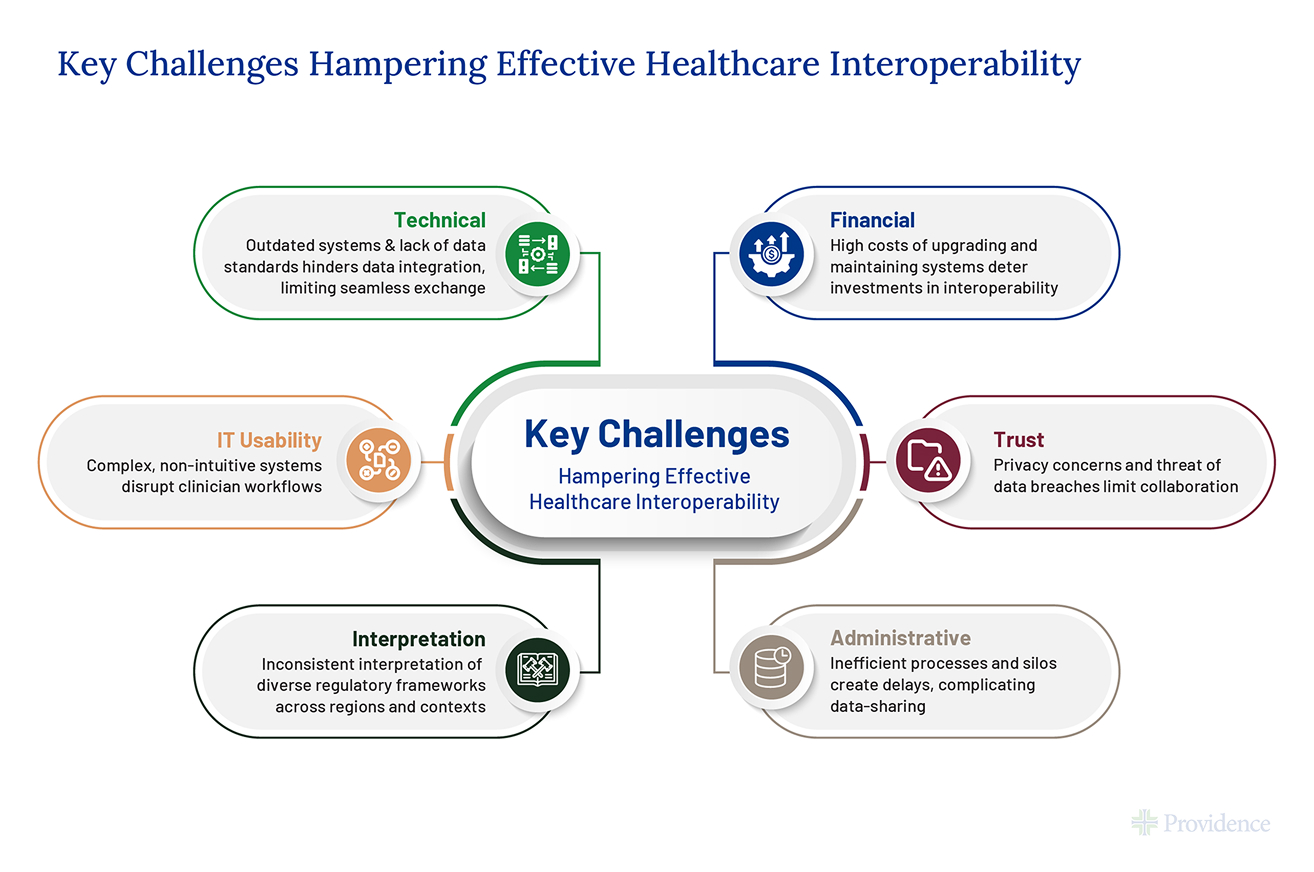
Technical Challenges: Many healthcare systems still rely on legacy infrastructure, which is often incompatible with modern standards like HL7 FHIR. These outdated systems lack standardized APIs and struggle to integrate with newer technologies, limiting seamless data exchange. As a result, data-sharing between systems with differing protocols, coding languages, or hardware becomes complex and inefficient, with inconsistent data quality and inaccurate patient data matching. Overcoming these barriers is critical to enable efficient, secure, and scalable healthcare interoperability.
Financial Challenges: The high costs of developing and maintaining health IT systems often limit investment in interoperability. Upgrading infrastructure, integrating systems, and hiring skilled IT personnel require significant financial resources, which can deter adoption, especially for smaller or rural providers. Ongoing expenses for system maintenance, training, and updates further add to the burden. Without sufficient incentives for data sharing or business models that prioritize data quality, organizations may deprioritize interoperability efforts, impeding progress in seamless healthcare data exchange.
Trust Challenges: Privacy concerns and competitive pressures often hinder seamless data exchange in healthcare. Organizations may view patient data as proprietary, fearing that sharing it could compromise their competitive edge or expose them to security risks and regulatory violations. Patients, too, may be apprehensive about unauthorized access or misuse of sensitive health information. This lack of confidence in data security frameworks creates hesitancy in collaboration, limiting the potential for effective care coordination and broader interoperability efforts.
Administrative Challenges: Complex billing processes, reporting requirements, and outdated documentation guidelines contribute to inefficiencies that hinder interoperability. These challenges often result in the inclusion of irrelevant or redundant information in patient records, complicating data sharing. Additionally, organizational silos, resistance to change, and misaligned internal processes exacerbate delays in implementing interoperability solutions.
Interpretation Challenges: Regulatory diversity, from GDPR to HIPAA, should enable interoperability rather than hinder it. These frameworks demand strong standards for data protection, transparency, and accountability, fostering trust in data exchange. The real challenge lies in consistent interpretation and application across regions and contexts.
IT Usability Challenges: Non-intuitive user interfaces and poor alignment with real-world clinical workflows make health IT systems cumbersome to use for clinicians, leading to inefficiencies and frustration during critical patient care moments. Slow or complex interfaces disrupt workflow and reduce productivity. Without user-friendly designs tailored to clinical needs, these systems fail to support seamless data sharing and effective healthcare delivery.
Technology-Driven Interoperability in Healthcare
Interoperability in healthcare relies on the seamless integration of diverse data types—such as omics, metabolites, microbiome, EHRs, wearable biosensors, ambient sensors, and environmental data—to drive personalized, efficient care. These data types are essential for various healthcare innovations, including precision health, digital clinical trials, and hospital-at-home models. The four layers of technology-driven interoperability play a crucial role in ensuring these diverse datasets can be effectively exchanged and utilized.
- Foundational interoperability supports the technical infrastructure that allows for data exchange, ensuring that systems can connect and share information securely.
- Structural interoperability ensures that the data is formatted correctly for exchange, making it possible for systems to handle complex data types like omics or wearable biosensor data.
- Semantic interoperability guarantees that the meaning of the data remains intact when transferred, ensuring that genomic information or environmental data is correctly interpreted across systems.
- Lastly, organizational interoperability facilitates the governance, policies, and processes that allow healthcare organizations to collaborate on using these data types for coordinated care, improving patient outcomes and enabling innovations like digital twins and virtual health coaching.
By addressing all four layers, healthcare systems can fully leverage the potential of these diverse data types to improve care coordination and outcomes, ultimately advancing value-based care. Acceleration of all above can be accomplished by integrating patient-centric technologies, AI and machine learning, real-time data exchange capabilities, and cloud-based solutions.
Patient-centric technologies like mobile health apps and patient portals empower individuals with access to their health data and facilitate communication with providers, enhancing data transparency and patient involvement. AI and machine learning, particularly agentic AI, solve complex interoperability challenges by enabling predictive analytics and natural language processing to integrate unstructured data and automate tasks like data cleaning and integration. Real-time data exchange, supported by IoT devices and wearables, allows for timely sharing of health information, crucial in emergencies. Cloud-based solutions offer scalable platforms for data storage and sharing, overcoming legacy system limitations and enhancing data security. Together, these technologies create a more integrated and efficient healthcare system, addressing key barriers and advancing patient-centered care.
The Critical Role of Health Information Exchange
A Health Information Exchange (HIE) system plays a pivotal role in enabling technology-driven interoperability by allowing different healthcare providers, patients, and other stakeholders to securely exchange patient data electronically, providing a complete picture of the patient’s health history. With electronic health information exchange, healthcare providers can access real-time, comprehensive patient data, leading to improved clinical decision-making. HIE offers several critical benefits, including the ability to avoid readmissions, prevent medication errors, improve diagnoses, and reduce redundant testing. By enabling the timely sharing of vital patient information, HIE enhances care coordination and reduces risks.
Standards and Regulatory Frameworks for Interoperability
The success of technology-driven interoperability in healthcare is highly dependent on adherence to well-established standards and regulatory frameworks. These standards ensure secure, efficient, and meaningful data exchange across healthcare systems. Key standards include HL7 FHIR (Fast Healthcare Interoperability Resources), which provides a modern framework for exchanging healthcare data via application programming interfaces (APIs), allowing systems to connect and share data more efficiently. TEFCA (Trusted Exchange Framework and Common Agreement) establishes a national framework for secure and standardized data sharing, ensuring consistency across organizations. The IHE (Integrating the Healthcare Enterprise) standards provide implementation guidelines to ensure interoperability in specific clinical scenarios. Additionally, Health Information Exchanges (HIEs) offer regional or national infrastructure for secure data exchange, promoting seamless communication between healthcare organizations. Other essential standards include ISO, OASIS, IEEE, DICOM, LOINC, and NCPDP, covering aspects such as data formats, terminology, workflows, and privacy/security requirements. These standards are crucial for maintaining data integrity, ensuring privacy and security, and improving healthcare outcomes. Regulatory frameworks like HIPAA (Health Insurance Portability and Accountability Act) further ensure the privacy and security of patient information during data exchange. By following these standards and regulations, healthcare organizations can build a reliable, secure, and effective interoperability framework, leading to improved patient care, reduced costs, and enhanced clinical decision-making.
Benefits of achieving technology-driven interoperability in healthcare are substantial and multifaceted. In addition to improved and efficient patient care, faster diagnoses, fewer errors, and better communication, interoperability reduces the time spent on administrative tasks, allowing healthcare workers to devote more time to patient care and improving resource allocation. Interoperability contributes to lower healthcare costs by minimizing duplication of tests, preventing medication errors, and eliminating unnecessary procedures.
Finally, a more interconnected system facilitates better data collection and sharing, which is crucial for research, population health management, and public health initiatives, ensuring more accurate and timely information for decision-making and future advancements in healthcare.
Looking Ahead: Seamless Care Delivery, Driven by Interoperability
As technology continues to advance, the ability to seamlessly exchange and access health data will accelerate transformation, streamline operations, and improve care delivery.
With recent advances in technologies, we can create a more integrated and efficient healthcare system, address key challenges and advance patient-centered care.
Now is the time for hospitals, providers, and healthcare organizations to invest in modern platforms, promote collaboration, and standardize data exchange protocols. The future of healthcare depends on it. By adopting interoperable systems, providers can continue to push boundaries of what’s possible through innovations in technology, creating a more connected, efficient, and patient-centric healthcare environment.