
Imagine if patients could access care from anywhere, at any time, with no communication barriers. The healthcare industry is undergoing rapid transformation, driven by increasing demand for personalized, convenient, and accessible care. Over 60% of individuals now expect to be able to schedule appointments, renew prescriptions, and access medical records online without hassle1. This shift has been accelerated by the involuntary surge in telehealth and virtual care, which grew by over 3,000% during the COVID-19 pandemic1.
At the same time, economic pressures are pushing healthcare providers to adopt more efficient models like value-based care and in-home services. These models require a strong foundation of modern and secure network. Legacy systems can no longer support bandwidth-heavy applications, real-time communications, or seamless data-sharing necessary for innovations like remote patient monitoring and AI-driven diagnostics.
Complexities in Modernizing Healthcare Network
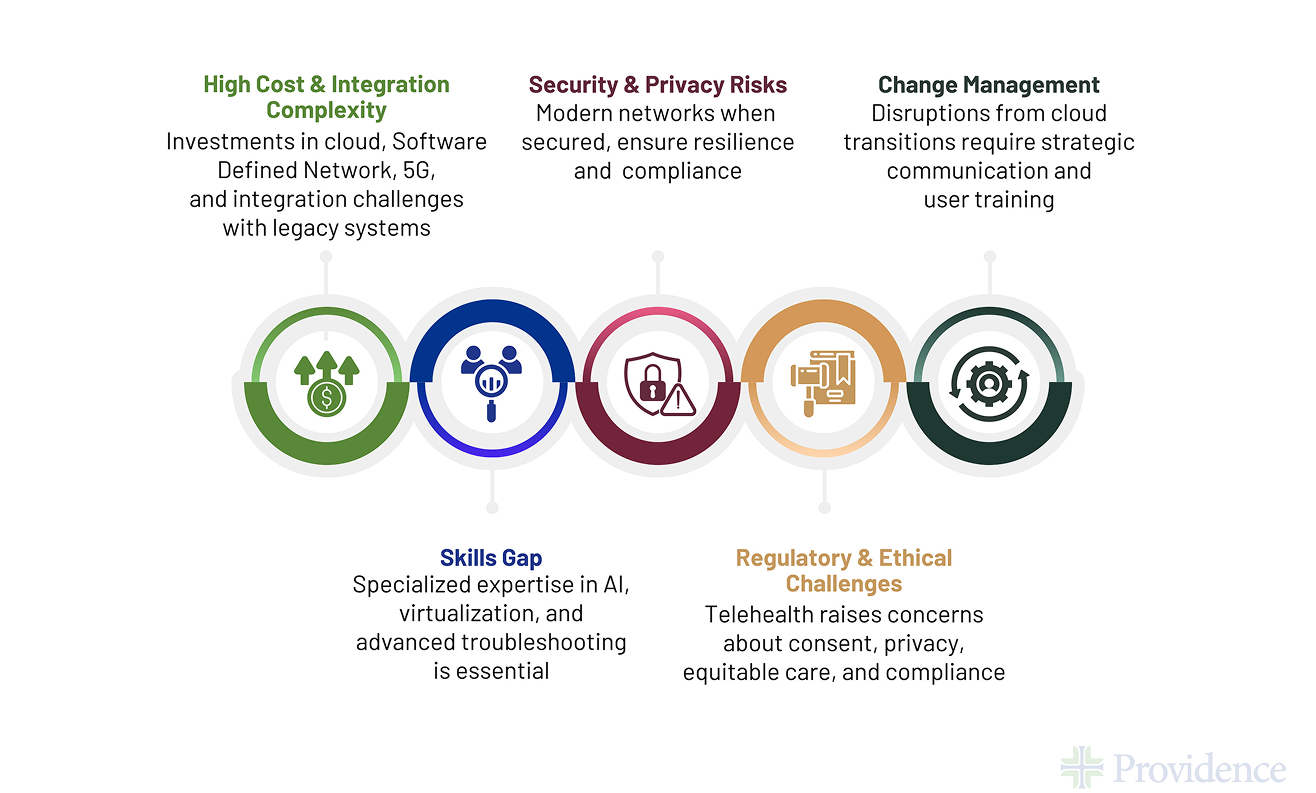
Network modernization in healthcare comes with its own set of challenges. The transition to new systems and technologies presents a complex landscape of hurdles that organizations must carefully navigate, considering any movement could possibly cost patients’ lives. Modernizing healthcare networks demands significant investment in technologies like cloud computing, Software-Defined Networking (SDN), edge computing, 5G, and unified communications. Integrating routers, firewalls and network components with cloud-based systems can be daunting, necessitating rigorous proper security protocols for comparable resilience to physical connections. New network technologies require specialized skills and knowledge of AI, data analytics, network virtualization. Modern network architectures need to be well-secured with robust protocols and complaint with regulations like Health Insurance Portability and Accountability Act (HIPAA) so they can provide strong resilience against breaches or unauthorized access. Technologies like telehealth raise regulatory and ethical concerns around patient consent, privacy, equitable care, etc.
Redefining Healthcare Systems by Integrating Key Components of Network Modernization
Understanding the pressing need for network modernization, organizations are upgrading and optimizing infrastructure to be able to support modern care models.
Network Architecture: Network architecture involves the design and structure of a network, detailing how components like routers, switches, firewalls, and servers are interconnected and configured. Modernizing network architecture means implementing more flexible, scalable, and secure solutions, such as cloud-based, software-defined (SD-WAN), or edge-based frameworks, to meet the high bandwidth, low latency, and high availability needs of today’s care models. According to Google Cloud, 93% of technology leaders have transitioned to cloud-based network architectures in some capacity2. The growing adoption of modernized network architecture is further reflected in the SD-WAN market, projected to reach USD 44.38 Bn by 20313.
Network Performance: Modern healthcare networks are essential for enabling seamless performance of telehealth solutions, including video conferencing and AI-based diagnostics. The integration of 5G networks is pivotal, as it provides the high-speed, low-latency connectivity required for time-sensitive applications such as robotic surgery. To further augment network performance, advanced infrastructure components like fiber-optic connections and next-generation wireless systems are indispensable. These technologies create a robust framework that supports a variety of healthcare applications, ultimately leading to improved patient outcomes and operational efficiencies.
Network Security: Enhanced network security is crucial for safeguarding sensitive patient data during telehealth sessions. Modernizing network security involves adopting advanced technologies like zero-trust architectures, AI-driven anomaly detection, and end-to-end encryption for proactive cybersecurity. Zero-trust ensures continuous user and device verification, reducing unauthorized access risks, while AI-powered anomaly detection enables real-time threat identification. Multi-factor authentication (MFA) adds an extra layer of protection by ensuring only authorized personnel can access patient data. Additionally, robust solutions like firewalls, antivirus software, and intrusion detection systems are increasingly used to protect healthcare networks from cyber threats and vulnerabilities.
Network Management: Network management focuses on monitoring, controlling, and optimizing network operations, including configuration, troubleshooting, maintenance, and backups. Modernization leverages advanced, automated solutions such as AI, machine learning, and analytics to enhance visibility, efficiency, and agility. Additionally, technologies such as predictive algorithms and self-healing networks address potential issues in network management, before they escalate, ensuring continuous operations vital for patient care. By shifting from reactive to proactive management, these solutions deliver seamless, intelligent operations, maintaining optimal performance and minimizing downtime in healthcare environments.
This process of modernizing your infrastructure begins with a detailed assessment of current systems, identifying limitations and future needs while analyzing intended care models like telehealth and remote monitoring. Clear goals should align with these models, for instance, ensuring compatibility with patient monitors and electronic health records (EHRs), along with efficient resource allocation.
Redesigning Connectivity for Optimal Healthcare Delivery
We recognize that network plays a crucial role in healthcare transformation where efficient connectivity directly impacts patient care. Organizations can consider redesigning their Wide Area Network (WAN) using Software-Defined WAN (SD-WAN) technology to transform and drive efficiency and cost-effectiveness. By consolidating routing design, standardizing platforms, and selecting dynamic solutions like SD-WAN, we can significantly improve our agility to handle bandwidth demands, enhance network management, and ensure real-time problem-solving capabilities.
For example, at Providence, our commitment to maintaining high standards is reflected in our lifecycle management metrics. We have consistently outperformed industry benchmarks, achieving nearly complete compliance in critical areas. Our hardware compliance processes have doubled efficiency over the past standard cycles, while our software lifecycle adherence sets a near-perfect benchmark, ensuring seamless transitions and support continuity.
A strategic shift like this one can position health systems to respond effectively to evolving healthcare needs while ensuring a robust and future-proof network infrastructure. With modern network infrastructure, organizations can offer personalized, efficient care, improving outcomes and reducing disparities. Streamlined processes can help drive cost savings and operational efficiency, while robust security ensures data protection and compliance, building trust.
Leveraging the latest technologies fosters innovation, attracts top talent, and positions health systems for better care outcomes. Modern technology paves the way for a more equitable, effective healthcare system that meets the needs of all.
1 Mckinsey: The next frontier of care delivery in healthcare
2 Google Cloud: The digital forecast
3 Global Software-Defined Wide Area Network (SD-WAN) Market – Industry Trends and Forecast to 2031